
Up Close & Personal, Combining Devastating, Short-Range Weaponry
“Briefly, I would just like to express my profound apologies for the lateness of this post. ‘Up Close & Personal’ was originally meant to be the November Blog post; however, due to on-going Internet problems during the month of November I was unable to post it then.
Karate Essence
‘Reality Check’
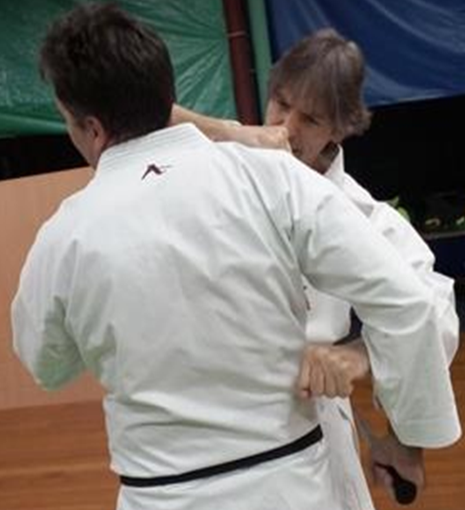
Up Close & Personal
Combining Devastating, Short-Range Weaponry
Editing by Zoe Lake
Here at the Karate Essence ‘Reality Check’, over the last couple of years, we have just about covered every single, individual technique that we train for self-defence.
During the aforementioned couple of years, we have established, more or less, that ‘self-defence’ is generally a very close-quarter affair. Also established is the fact that defending against an attack – rather than simply fighting – requires an attack to take place… or that at least the intent of an attack can reasonably be assumed to be about to take place.
Table of Contents
Self-Defence Ground Rules
Wing Chun Close Quarter Self-Defence
Goju Ryu Close Quarter Self Defence
Northern Praying Mantis Kung Fu Elbow & Knee Strikes
MMA Knees & Elbow Use
Kyokushin Knees & Elbows
Shotokan Knees & Elbows
Torakan Eye View
Conclusion
Self-Defence Ground Rules
My apologies if the second paragraph in the opening segment seemed a little vague. It is essential to understand that a person’s frame of mind would be important, if a court of law became involved, to establish your right to defend yourself. I am particularly addressing Australia, the USA and the UK here; however, I have researched most European countries, and they seem to be in accord, as do most Asian countries. The wording may be slightly different from country to country, but a general rule is that self-defence, to protect oneself or another is a ‘right’; however, certain conditions apply:
Subjectively, based on the individual’s perception of the threat at the time, the individual must believe that their self-defence action is necessary to protect themselves or another person from harm.
The danger must be imminent, or actively occurring. In other words, if you hear that someone intends to attack you sometime in the future, you cannot then go and attack them first. Further to that, you cannot search them out, post attack, to seek retribution.
Proportionality: the force you use should be proportional to the force you perceive is directed against you, or about to be used against you. In other words… if the attack against you, or another, stops and the attacker walks away, you are not allowed to carry on and beat the attacker to death.
As I said earlier, the wording might be a little different but the sentiments are similar in many countries.
Wing Chun Kung Fu, Close Quarter Self-Defence
I tend to reference Wing Chun in regard to their close-quarter self-defence applications because, basically, their self-defence criterion is extremely practical. Further to that, they have no other agenda in their martial art other than self-defence (no sporting aims, and no grandiose claims). Also, their art is purported to have been founded by a woman during the Qing Dynasty, about 300 years ago, by a Buddhist nun, Ng Mui. She was a master of Shaolin Kung Fu; and so the Wing Chun self-defence system was designed to work against a larger adversary.
Quite apart from Wing Chun’s ancient foundation, it is famous for being the no nonsense art that the renowned Bruce Lee began his illustrious career with. It also gained more notoriety when his teacher, Ip Man, was immortalised in a series of high-profile movies about his life, starring Donnie Yen.
With no pretence of being power strikes, the Knee and Elbow strikes are more accurate, unannounced shots at delicate or vulnerable targets. Wing Chun emphasises the use of Knees and Elbows as tools in close quarter encounters.
Goju Ryu, Empi & Hiza Geri
Goju Ryu is a classical Karate style which originates from Okinawa, where it was designed for mainly close quarter combat. The short range part is evident in their Kata, and demonstrates the style as an effective self-defence.
As with Wing Chun, Goju Ryu has many close-quarter strikes, kicks, grapples, throws and takedowns, and featuring among them are Empi (Elbow Strikes) and Hiza Geri (Knee Kicks or Strikes) combined defensive counter attacks.
Northern Praying Mantis Elbow & Knee Strikes
This particular style of Kung Fu was developed by Master Wang Lang, a Shaolin Monk, during the ‘Song Dynasty’, sometime during the 13th century AD.
Northern Praying Mantis Kung Fu emphasises short range techniques such as Knee and Elbow strikes for effective self-defence. Knee & Elbow strikes are used in almost all martial arts; and although some arts use them only in a clinch or a brief, standing grapple, this art has them as a major part of their art.
The following link is a Knee tutorial, with the odd Elbow thrown in: Kung Fu Xi Ti
This next tutorial is fuller, giving a more complete picture of the scope of their Elbow Strikes.
MMA Knees & Elbow Use
I have said more than once through the course of time that I have been presenting the ‘Reality Check’ that, for a while I wasn’t including MMA techniques; and I explained that even the name, Mixed Martial Arts, kind of side-lined it because I would be presenting the techniques they use already, in say Muay Thai Knees, or Elbows et cetera. However, MMA has proven itself to be an art unto itself.
The ‘Reality Check’ monthly exposé has a core purpose, and that is to test techniques that are practiced by various martial arts and therefore should be useful in a reality based ‘Self-Defence’ scenario.
Well, we know that MMA, like Muay Thai, is a combat sport; and, as I have pointed out in regard to any of the combat sports, you react, in an adverse situation, the way you repetitively train.
So, even though there are very few restrictive rules in MMA, ‘there are rules’; also, you train to fight just one person at a time. I am not saying that an MMA fighter could not cross any of these barriers; and, certainly, the intensity of their training and fight experience alone would make them formidable self-defence exponents. However, when you are attacked, by surprise, and by more than one opponent, with no referee and no rules, it is a different situation entirely.
Muay Thai Elbow & Knee Strikes
Muay Thai is a combat sport, derived from several Thai martial arts that were collectively known as Muay Boran, a battle tested martial art. Before it became the sport of Muay Thai Boxing, Muay Boran was tempered and refined in the heat of battle, over hundreds of years, by the Siamese (Thai) armies.
From the 1930s these various Thai martial arts began to be regulated to form the combat sport of Muay Thai Boxing. Sometimes referred to as ‘the art of 8 limbs’: 2 fists, 2 shins, 2 knees, and 2 elbows; Muay Thai is one of the toughest stand-up combat sports. Muay Thai Elbows are flowing, deceptive, and are some of the most devastating Elbow Strikes of all the various martial arts; and with the knee strikes, no other martial art comes remotely close to Muay Thai.
The Elbow and Knee techniques of Muay Thai are, without question, what sets the ancient ‘Art of 8 Limbs’ apart from all other striking-based combat sports. Because there are so many different ways, in Muay Thai, to deliver Knee & Elbow strikes, they are excellent for any kind of fighter; and there are so many ways to use them in self-defence situations.
Not unlike MMA, the only caution I have to those who train Muay Thai is, if you are attacked, by surprise, and by more than one opponent, with no referee and no rules, it is a different situation entirely.
I’m going to leave you several Muay Thai Knee & Elbow tutorials.
Kyokushin Karate Hiza Geri & Empi Uchi
It depends where you train, what dojo, which trainer, and what their main focus is – and I believe that would be the same across the board, regardless of the style – but as a general rule, Kyokushin’s main focus is training for their particular style of hard, full contact, knockdown Karate. I’ve featured Kyokushin in several ‘Reality Check’ articles and I always speak with a healthy respect for Kyokushin practitioners. They are a tough, no nonsense style of Karateka, and they train to give and take hard-core punishment. They use knees in their style of competition fighting, and so, with the training they put in (remember you react the way you train) their Hiza Geri is as you would expect… destructive. They perform Empi in their Kata, and therefore in their self-defence training. However, I believe that, because of their avoidance to head contact with hands (in their form of competition) it would affect instinctive elbow strikes to the head. Having said that, I believe they would make an effective close quarter self-defence with Empi.
Shotokan Empi Uchi & Hiza Geri
With Shotokan, the whole range of Elbow strikes are covered; however, it depends on which dojo you frequent as to how much attention is paid to the practice of said Empi Uchi techniques. Many Shotokan Dojo, who focus intently on the sporting competition side of Karate (like many other Karate and martial arts styles), will pay little attention to Budō techniques that are not permitted to be used in competition because they are considered too dangerous. Empi Uchi is just such a technique; however, it is an excellent self-defence weapon.
I would go as far as saying that Empi Uchi is one of the best, singular, ‘go to’ self-defence techniques in the whole Shotokan armoury.
The Shotokan Hiza Geri is again hampered by the fact that they have a noncontact sport attached to the art. I’ve been around a very long time and so I remember, in my early competition days, usually fighting other Shotokan fighters, we fought what we termed ‘controlled contact’, Ippon or Sanbon Kumite; however, even then, Hiza Geri was considered too dangerous to use in competition fighting. However Hiza Geri is practiced in so many Kata that it is obviously passed down as a solid self-defence technique; and, together with Empi, was obviously meant to be a stable Shotokan self-defence weapon. However, it does not get the attention needed to hone into the weapon it might otherwise become.
Also, in my opinion, the Shotokan Empi Uchi is not only one of the most devastating single techniques in the Shotokan system; the strike itself is one of a few of the most powerful Elbow strikes throughout the whole of the martial arts.
Torakan Eye View

As a boxer, I learned what I later came to know in Karate as Mawashi Empi (roundhouse Elbow strike). However, in Boxing it is a foul, a dirty technique delivered in the clinches and, when pulled up for it, you swear it was an accident, and that you were really attempting a ‘left hook’.
I have loved Empi Uchi since my very first Shotokan Elbow strike, that was Yoko Empi (a side thrusting Elbow), and it comes fairly early in your Kihon training. From there it only gets better, but mostly it is brought to you via the Kata. You can deliver the Elbow strike from any position, thrusting sideways, driving forward, back, upward, and downward; you can deliver it in a roundhouse, or spinning.
However, for it to work, you realise that you have to be in close range, and that it would be in self-defence circumstances. That’s why – along with ‘Hiza Geri’, especially when you are outnumbered – it is perfect in confined spaces, close proximity crowded conditions, for self-defence while working crowd control.
When I began my Muay Thai training, I learned a whole other way of delivering an Elbow strike. The Elbow strike can be anything from solid and singular to flowing within a combination; it can be the first line of defence and or ‘le coup de grâce’.
Working in high-risk security for thirty years, I can only hazard a guess as to how many people, in self-defence, I had to knock out, but I do know that the Elbow strike never failed to stop an attacker, and Hiza Geri was often a set-up for that.
The following short video clips will give you an idea how we, at Torakan Karate-Do, utilise this close-range weaponry to maximum effect.
Conclusion
In conclusion, I would say that martial art practitioners who have a wide range of Knee and Elbow strike training, and who hone them to perfection, are those individuals who have a sporting form in their martial art which allows Knee and Elbow strikes in that format. I will, of course, concede that competitive fighters in the above stated forms will have more polished Knee and Elbow striking techniques. However, we are back to the, ‘you react under pressure the way you repetitively train.’
There is a huge difference between ‘taking part in a competition, or even a serious fight (as in a 'one-on-one' agreed upon conflict)’, and ‘using self-defence’ to (perhaps) save your life. So, in a self-defence situation, it is imperative that we totally abandon any ideas of illegal targets and of fighting ‘fair’ in any way whatsoever. Adverse situations concerning self-defence rarely entail just one adversary; and there is a world of difference between fighting one person, with rules (no matter how kick-arse you or that opponent may be), and being taken by surprise by two, or three, or four or more antagonists who, perhaps, are intent on taking your very life.
Anyone who knows me, or follows the monthly ‘Reality Check’, will know my philosophy regarding ‘Mushin’. Not training to fight… but training so that you do not have to think about what to do if you have to defend yourself in an adverse situation. Self-defence is not fighting! Self-defence has no referees or judges and only one rule… ‘Survive!’
If you are attacked or are about to be attacked your ‘Mushin’ will supply you with the required reaction if, that is, you have supplied your ‘Mushin’ with the appropriate preparation. Empi Uchi and Hiza Geri, in their various guises and computations, are definitely weapons you need to supply to your ‘Mushin’. A well-placed ‘Empi Uchi’, ‘Hiza Geri’ combination, delivered by virtually anyone (even a small, slightly built individual or a woman), could indeed end the conflict very quickly.
Whatever the bulk of your training regime may be… I believe that it is worthwhile to incorporate a strictly ‘Self-Defence’ aspect to your training, so that your ‘Mushin’ always retains an appropriate, instinctive response.

Thank You
A big thank you to our demonstrators from Torakan Karate-Do; without whose assistance, of course, the ‘Reality Check’ Blog would be sadly lacking. Assisting me this month were Tyler, Alan, Rahul and Anthony. And as always, a special thank you to Kelly, our Media & Public Relations Officer, AKA our technical wiz.
I would also like to mention and thank my Editor, Zoё Lake. Not only does Zoё edit all of my books, she edits all of my articles, Blogs, and in fact everything I write and publish. Thank you Zoё.

Thank You to the Readers
As always, thank you for following the Karate Essence 'Reality Check' Blog post. Once again, my profound apologies for the November, Karate Essence ‘Reality Check’, Blog post.
I know you will understand, this being an extremely busy time of the year, when I say that, ‘Up Close & Personal’ will serve as the December Blog post; and I will be back with a brand new series for the Karate Essence monthly Blog in January of 2026.
Thank you also for continuing to support my latest book, ‘A Budōka Odyssey’; the reviews continue to be outstanding!

Top reviews from Australia
Reviewed in Australia on 8 April 2025
Verified Purchase
This book is easy to read in short or long sessions - such an inspirational life story of an amazing guy. Well worth the read.
5.0 out of 5 stars
Reviewed in Australia on 28 May 2024
Written by a man who has lived the life of a modern warrior. His ability to recognise the lessons and gifts in any situation and the having the humility to seek out those who can help you better yourself are important traits we should all endeavour to achieve not just in our own martial arts’ odyssey but in life.
Top reviews from the United Kingdom
Carl Slee
5.0 out of 5 stars
‘A Fascinating Book’
Reviewed in the United Kingdom on 23 October 2024
Verified Purchase
A fascinating book, and not just for those interested in martial arts. Although if you are, this is one of those rare books that will help in not just the development of karate skills but in the facilitation of those psychological states (rarely discussed) of the true karateka.
From early childhood to the present day, Shihan McKinnon shares his adventures as, Truant, Soldier, Nightclub bouncer and Bodyguard as well as Business man but always as a fighter. And in this book he shares with us the ‘gifts’ and ‘Lessons’ that come from such a ‘life worth lived’.
A rare book, in that I found myself re-reading pages, chapters or passages over and over to further understand how such insights related to my own life. And this is the ‘gift’ of this book, I think that each person, whatever gender, age or interest will find something at some point within it, that is very personal and that will reverberate for them, long after reading.
Thank you Shihan
Reviewed in the United Kingdom on 20 July 2024
I have to say that I found this book to be compulsive reading. For someone who was born and raised in the West of Scotland I was immediately drawn to T.D. McKinnon’s Scottish roots. He writes in such a concise and realistic manner. As someone with no knowledge of karate and martial arts, I have nevertheless found the main themes of the book easy to follow and this has made me review experiences drawn from my own life. The concept of ‘gifts and lessons’ applies to all life, not just karate. I would recommend this book to anyone, particularly those who are deeply involved in a sport of any kind, and who is striving to be the best person they can be. Read, learn and enjoy.
Thank you for this book, T.D. McKinnon.
Top review from the United States
Minimal shopper
5.1 out of 5 stars
‘A Fine Man Shares a Life of Budō’
Reviewed in the United States on May 18, 2024
Verified Purchase
At over 500 pages there is a lot of content in this autobiographical journey. A quick overview is as follows:
Author Shihan TD McKinnon has had ALOT of fights in his life; starting under the age of 6! He tells the narrative of his life through all those fights and what he learned about himself and life along the way. I appreciate that he doesn’t make self-defense fighting seem glamorous and one sided. He talks about injuries, dangers, and making alternate choices to physical violence as a reality.
This book emphasizes lessons like ‘never quit’, ‘move on to the next venture’, ‘stay in the moment and learn what you can along the way’. I recommend it for young and old, karate people and non-karate folks. He carries the journey into today with a very relevant subject - training and aging. Take it on your next plane trip, or beach vacation. And if you’re a karate instructor, you can work it into your teaching.
This book does not disappoint!


Comments